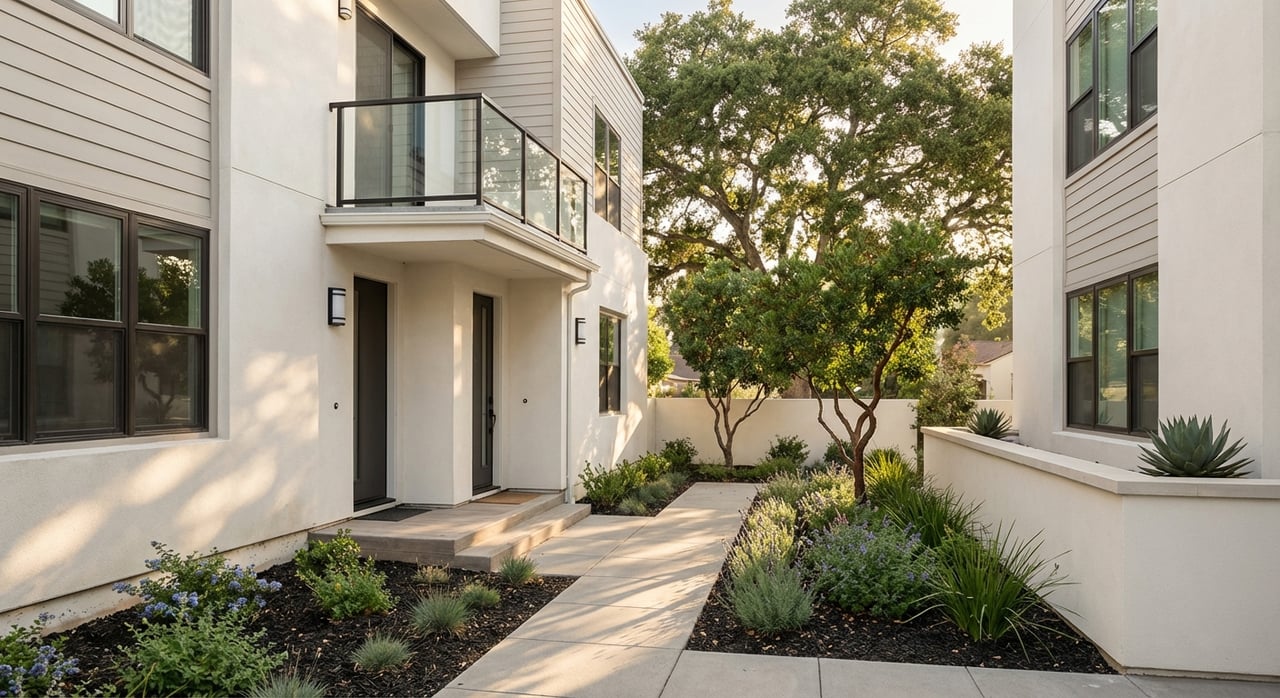
Thinking about a condo or townhome in Sunnyvale but unsure where to start? You are not alone. The market moves quickly, prices vary by building and age, and HOA rules can affect both lifestyle and financing. In this guide, you will learn current price ranges, what different buildings offer, how HOAs and financing work, and which micro-markets to watch so you can buy with confidence. Let’s dive in.
Sunnyvale condo and townhome prices now
Sunnyvale is a fast-moving market. As of January 2026, the citywide median sale price for all home types was about $1.9 million, and homes often go under contract within a few weeks. Condos and townhomes offer more approachable entry points compared to single-family homes.
- Condos: around $1.3 million for the citywide median.
- Townhomes: around $1.5 million for the citywide median.
- Single-family homes: typically in the low-to-mid $2 million range.
If you are starting your search, here is a quick range check based on current listing patterns in Sunnyvale:
- 1-bedroom condos: commonly mid $600,000 to $900,000 in older buildings. Newer, walkable or downtown units can trade higher.
- 2-bedroom condos: roughly $800,000 to $1.3 million or more depending on age, level, parking and finishes.
- Townhomes (2 to 3 bedrooms): high $700,000 to $1.9 million or more, with many newer 3-story units clustering around $1.2 million to $1.9 million.
These figures are citywide snapshots. Your price will depend on exact location, age, square footage, parking, HOA dues, amenities and in-unit upgrades.
What you get by property type
Condos: older garden blocks to modern infill
Many Sunnyvale condos from the 1960s to 1980s are garden-style communities with assigned parking and simpler amenity sets. These often have smaller floor plans and relatively modest HOA dues, which appeals to entry buyers who prioritize price and convenience. Newer for-sale condos near downtown and the Caltrain corridor arrived in the 2010s and 2020s, trading at a premium for walkability and transit access.
What to weigh:
- Floor level and exposure can affect noise and light.
- Parking varies by building and can be a major value driver.
- HOA coverage differs. Some include water, trash or gas, which changes your monthly cost picture.
Townhomes: house-like layouts with lower exterior upkeep
Sunnyvale townhomes are usually multi-level attached homes with 1 to 2 car garages and small patios or yards. You get a more house-like layout, typically higher bedroom counts, and less exterior maintenance than a detached single-family home. You will find clusters from the 1990s to 2010s and newer infill near transit and major corridors. Locations close to downtown and Caltrain often command a premium for convenience.
HOA costs and what they cover
Monthly HOA dues in Sunnyvale vary widely, roughly $250 to $800 or more. Older, simpler communities tend to sit on the lower end. Buildings with pools, gyms, elevators, lush landscaping or extensive common utilities land higher. Always budget for HOA plus mortgage when comparing a condo or townhome to a house.
When you are in escrow, review the HOA documents carefully. Ask for the complete packet and read:
- CC&Rs and bylaws
- Current budget and reserve study
- Year-to-date operating statement
- Board meeting minutes for the last 12 to 24 months
- Insurance certificates
- Any pending special assessments or litigation
This documentation helps you spot red flags like low reserves, repeated special assessments, high delinquency rates or active litigation. For a helpful overview of what to look for, see this practical guide to reviewing HOA documents for condo buyers.
Rules that affect rentals are just as important. Under California Civil Code, HOAs cannot impose rental caps below 25 percent of units, and most can restrict short-term rentals of 30 days or less. Always confirm current policies in writing before planning to rent a unit. You can read more about statewide parameters in this summary of California HOA rental restriction rules.
Locally, Sunnyvale also maintains a Residential Tenant Protections Program with relocation assistance provisions. If you plan to rent your unit or buy a tenant-occupied property, confirm how these rules interact with your plans by reviewing the city’s tenant protections program materials.
Financing factors that surprise condo buyers
Lenders do not only underwrite you. Many will also review the condo project itself. Issues like inadequate master insurance, low reserves, significant deferred maintenance, high HOA delinquency or pending litigation can make a project ineligible for conventional conforming loans. Ask your lender early to check project status using tools like Fannie Mae’s Condo Status Finder, and review the Fannie Mae Selling Guide list of ineligible project factors.
Loan size matters too. Santa Clara County is a high-cost area in 2026, with a one-unit conforming loan ceiling of about $1,249,125. Many Sunnyvale condos and townhomes price near or above that. If your loan amount exceeds the local conforming limit, you will likely use a jumbo product with different underwriting and reserve requirements. For reference, see the 2026 loan limit announcement.
Practical next steps:
- Ask for the HOA resale packet early and share it with your lender.
- Confirm whether the project is eligible for conventional financing or if jumbo is required.
- If investor concentration is high or litigation is present, be ready to adjust financing or consider alternate buildings.
How to read Sunnyvale condo and townhome comps
Pricing a condo or townhome is more precise when you focus on the same building or immediate complex. Use this simple process that mirrors what appraisers do:
- Compare within the same property type and ideally the same complex first. Same-building sales control for location and amenities.
- Use recent sales. In fast markets, the last 3 months are best. Stretch to 3 to 6 months only if inventory is thin.
- Match size and layout. Keep square footage within 10 to 20 percent and match bedroom and bathroom counts when possible. Note deeded parking and storage.
- Adjust for condition and features. Floor level, light, views, in-unit upgrades, and HOA differences (fees and what they include) can materially change value.
- Cross-check actives and pendings. They show current momentum and help you reconcile a range rather than a single number.
If you want help building a clean, data-backed comp set and translating it into a list or offer strategy, we can walk you through it step by step.
Neighborhood micro-markets to know
- Heritage District and Downtown Sunnyvale. Newer infill condos and townhomes near Murphy Avenue and the Caltrain station trade at a premium for walkability and transit access. If you value car-light living or cross-county commutes, this area is worth a close look.
- Lakewood and North Sunnyvale (94089). You will find clusters of attached townhomes, including some newer product. These pockets often show more value-oriented pricing compared to west-side Sunnyvale.
- Moffett Park and Lawrence areas. Proximity to major corridors like 101 and 237, plus nearby campuses, can make these locations efficient for commuters. Planned townhouse communities near office parks appeal to buyers who want quick highway access.
When comparing these areas, factor in commute patterns, not just price. If you split commutes or work hybrid, weighing transit plus highway access often narrows the field quickly.
Investor lens: rents, yields and rules
Sunnyvale rents are healthy, but purchase prices are high, which keeps gross yields modest. Recent rental trackers show average rents around $3,300 to $3,800 per month for typical 1 to 2 bedroom units. You can explore current averages by bedroom type on RentCafe’s Sunnyvale rental trends.
Illustrative yield examples using city-level medians:
- If a 2-bedroom condo is about $1.3 million and average rents are about $3,800 per month, gross yield is roughly 3.5 percent (about $45,600 annual rent divided by $1,300,000 purchase price).
- For a $1.5 million townhome with similar rent, gross yield is about 3.1 percent.
These are gross figures before mortgage, HOA dues, maintenance and vacancy. Many investors prioritize appreciation or focus on very specific buildings that outperform the average on rent or HOA coverage.
Know the rules before you buy. California’s AB 1482 sets statewide rent caps and just-cause eviction rules for many properties, and Sunnyvale layers on local tenant protections and relocation assistance. Review a clear overview of AB 1482 here: California rent control and eviction protections explained, and double-check your HOA’s rental policy and any caps before making an offer.
Quick buyer checklist
Use this as a working list when you tour and write offers:
- Confirm current medians and active listing prices for your target buildings and neighborhoods, and note days on market.
- Ask for the HOA resale packet early. Read CC&Rs, bylaws, the current budget and reserve study, financial statements, minutes, insurance, and any litigation or special assessments.
- Verify any planned or recent special assessments and HOA delinquency levels.
- Check HOA rental rules and whether a rental cap is in place. Short-term rentals are commonly prohibited.
- Have your lender review condo project eligibility before you make a financing-contingent offer. Use tools like Fannie Mae’s Condo Status Finder.
- Confirm if your purchase will require a conforming or jumbo loan based on the 2026 high-cost ceiling for Santa Clara County.
- Build a comp set using 3 to 6 recent sales from the same building or immediate area and adjust for HOA dues and included utilities.
- If you plan to rent, review AB 1482 and Sunnyvale’s tenant protections and ensure the HOA permits rentals.
Red flags to avoid
- Low or no reserves, frequent or large special assessments, or unclear minutes about capital projects.
- Significant active litigation against the HOA.
- High HOA delinquency rates or inadequate master insurance coverage.
- Condo projects that do not meet conventional financing guidelines, which can force non-conforming or cash-only purchases.
- A mismatch between your plans and the CC&Rs, such as expecting to do short-term rentals when they are prohibited.
You can learn more about project eligibility hurdles in the Fannie Mae ineligible projects summary.
The bottom line
Condos and townhomes in Sunnyvale give you a faster entry point than single-family homes, especially if you want a central location or lower exterior maintenance. To make a confident move, anchor your search in real comps, read the HOA packet closely, and line up financing early so project eligibility does not derail your plan. If you want a second set of eyes on a building’s financials, a comp range for your target complex, or a clear mortgage path, we are here to help.
If you are ready to explore Sunnyvale condos and townhomes, schedule a friendly, no-pressure consult with Sandra Darrow Realty, Inc. to get a tailored plan for your budget, timeline and goals.
FAQs
What is the current median price for Sunnyvale condos and townhomes?
- City-level medians are about $1.3 million for condos and $1.5 million for townhomes as of January 2026, while single-family homes sit higher in the low-to-mid $2 million range.
How do HOA dues in Sunnyvale typically range, and what do they cover?
- Expect roughly $250 to $800 or more per month, depending on age, amenities and common utilities; dues often cover exterior maintenance, landscaping, insurance on common areas and may include water, trash or gas.
Can HOA rules stop me from renting out my Sunnyvale condo or townhome?
- California law sets limits on how restrictive HOAs can be, but many associations cap rentals and ban short-term stays of 30 days or less; always confirm the current rental policy and any caps in the HOA documents.
What financing hurdles are unique to condos in Sunnyvale?
- Lenders review the condo project for reserves, insurance, litigation and owner-occupancy ratios; projects that do not meet standards may not qualify for conventional loans, which could push you to jumbo or non-conforming products.
Do Sunnyvale condos and townhomes cash flow well for investors?
- Given high purchase prices and average rents around $3,300 to $3,800 per month, gross yields often pencil in the low single digits, so many investors focus on appreciation or carefully selected buildings.
Which Sunnyvale areas should I prioritize for walkability or transit access?
- The Heritage District and areas around the Caltrain station offer the best walkability and transit access, while north and east pockets near 101 and 237 favor driving commutes.